
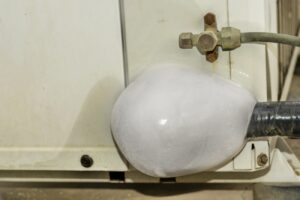
 If someone asked you where you most expected to observe ice forming, you’d probably say on the streets in the wintertime, or maybe inside your freezer. These are sensible responses! What isn’t sensible, however, is seeing ice anywhere on your cooling system. Maybe you’ve never considered this, and maybe the first time you discover it, you’ll think it’s normal. After all, cooling systems chill the air, right?
While air conditioners do chill the air, ice is never a part of the process, and if you see it developing anywhere on your air conditioner, it’s not okay. Of course, this doesn’t mean you should try to remove the ice on your own–this can damage the system further and not get to the root of the problem causing the ice. So, your next step should be to call our team!
In the meantime, however, read on to learn a bit more about why this happens.
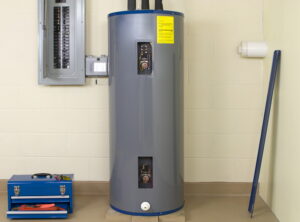 Of all the things you enjoy within your household, we’re going to guess that a warm, or even hot, shower in order to get clean and refresh is at the top of your list. This also means that there is nothing worse than being in the middle of that shower and having the water suddenly turn ice-cold.
 In our
 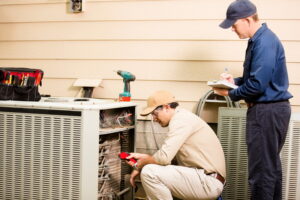 Have you ever wondered when the right time to schedule professional air conditioning maintenance is? If you ask a qualified and experienced HVAC professional, they’ll likely tell you that the answer is in the early spring, before you actually need your cooling system the most.
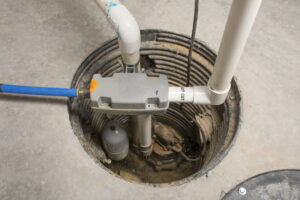 For homes in our climate, the sump pump is a staple appliance, resting in the basement or otherwise the lowest point of a property. Sump pump systems help you avoid water damage due to flooding, switching on automatically as they gather excess water in the pit (sump) and then pump it out, either to a well or a wastewater system.
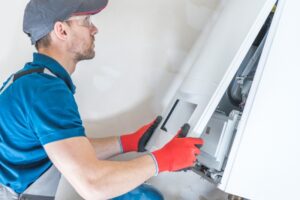 Modern heating systems are designed to last a very long time, but no heater can last forever, unfortunately, And when your heating system starts to show signs that it’s about to fail, it’s important to get a replacement as soon as possible. Far too many people wait and end up paying more month-to-month for inefficient heating operation, and potentially even facing a total breakdown.
 Wouldn’t it be great if we lived in a time that HVAC systems were created to make no noise at all? While we can’t promise that will ever happen, we can say with certainty that your HVAC systems may make sounds, but they should be that loud.
 This is a popular time of year for many indoor remodeling projects since homeowners aren’t typically spending a whole lot of time outdoors. However, small remodeling projects can become huge headaches if they’re not done correctly, or done without any professional assistance.
 Perhaps you haven’t put a whole lot of thought into the state of your heating system lately. We’d be a bit surprised if this was the case, since it’s certainly been cold here recently! But maybe you’re just relying on it to work as efficiently and effectively as ever without giving it a second thought.
 The absolutely last thing you need to worry about during this time of the year is whether or not your heating system is going to make it through winter. Of course, if your furnace has been routinely maintained by a professional and you keep on top of your heating repair needs, this shouldn’t be a concern.